Gangster Miami RP: Grand City
- 4.7
- Rating
- 5.00M
- Installs
- Free
- Price
 Analysis by App-foxy
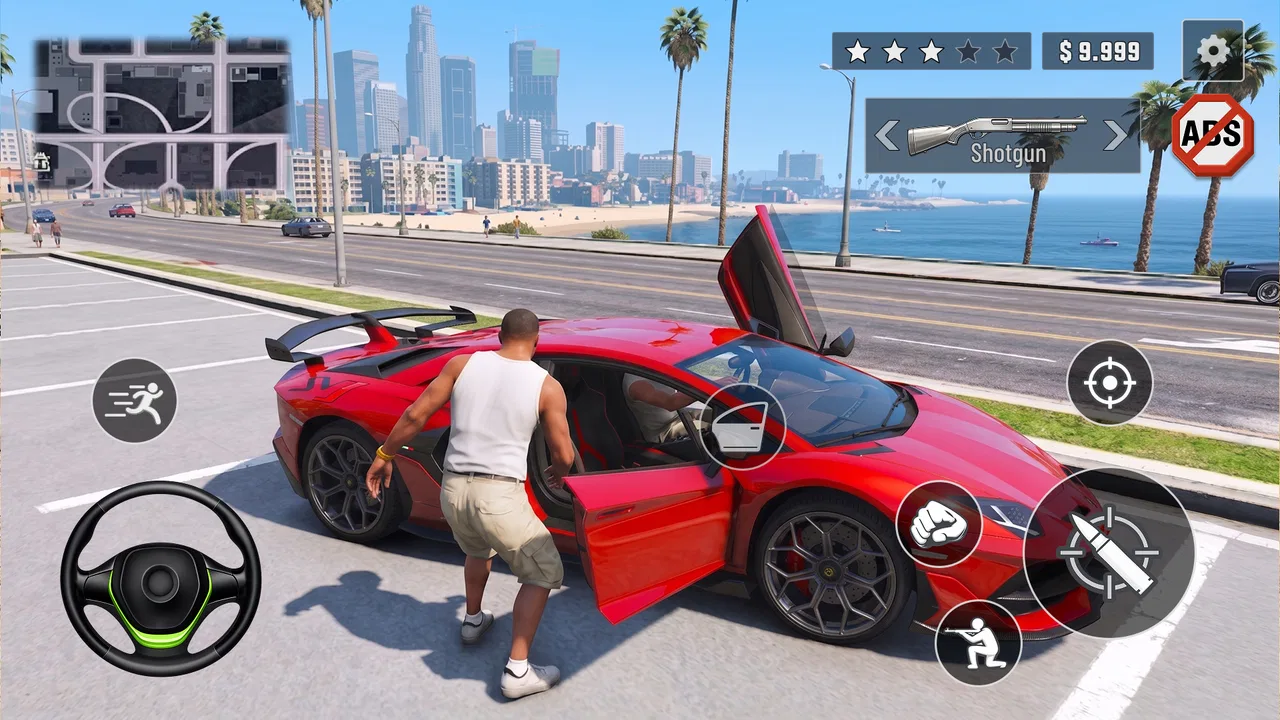
I approached Gangster Miami RP: Grand City as a decision rather than assuming that every open-world role-playing game suits the same player. Its appeal is easy to understand: it places the idea of a gangster-themed city adventure at the center, with room for action and role-playing instead of a single, tightly controlled path. That combination can be attractive when I want a quick escape into a city setting, but it also raises an important question: do I want a flexible urban playground, a structured story, or a more focused role-playing experience?
This is a free game from Universe Game Labs in the role-playing category. It is available for everyone, has reached over one million installs, and carries an average score of 4.5 from around two thousand ratings. Those figures suggest that the basic concept has found a sizeable audience, but they do not decide whether it is right for you. My recommendation depends more on how you like to spend short gaming sessions, how much freedom you expect from an open city, and whether you are comfortable with the rough edges that often come with a broad action-focused design.
How I Decide Whether This City Game Fits
I judge whether a city game belongs on my phone by what remains enjoyable once the first burst of curiosity has passed. Here, I’d pay attention to whether I can build a comfortable routine around roaming and action, rather than expecting the game to supply a reason for every return. That makes the next question practical: how much effort does it take to keep playing on my own terms?
You May Also Like

 Blood Strike: 2.5 Anniversary
Blood Strike’s Loadouts Turn Every Drop Into a Tactical Gamble
A close look at Blood Strike’s custom loadouts: how fast access to signature weapons reshapes its battle royale rhythm, rewards preparation, and narrows the gap between fights.

 Pandora - Music & Podcasts
Pandora’s Music Is Easy to Start, but Harder to Recover
Pandora’s strength is its low-effort path from a seed to a station. Its weak spot is how much confidence it asks you to place in connection, setup, and quiet recovery.

 8 Ball Pool
 Is Built on Rivalries, Rematches, and Routine
A close look at the rivalries, rematches, shared routines, and unanswered safety questions that turn a quick pool match into a persistent mobile community.

 Samsung Music
’s Quiet Strength Is Playing What You Already Own
Its reach comes less from spectacle than from dependable access to a personal library. That simplicity is both the app’s strongest retention engine and its ceiling.

 AccuWeather: Weather Radar
AccuWeather Review: A Quick, Clear Forecast for Everyday Decisions
For everyday plans, the best forecast is the one you can understand quickly. AccuWeather makes rain timing, radar, and local conditions easy to act on, with a few trade-offs.

 Hill Climb Racing
Why Hill Climb Racing Still Turns Crashes Into One More Run
A tiny car, a bumpy hill and one more upgrade: Hill Climb Racing keeps resurfacing because its simple chaos makes every near-miss feel personal.
More From Our News Desk
View All News


The first choice is freedom versus structure
My first decision point is the kind of direction I want. A conventional role-playing game usually gives me a clear chain of missions, character progression, and a sense that each activity is moving the story forward. A city-based action game offers a different pleasure: I can enter the environment, experiment with movement and encounters, and create my own rhythm. The Gangster Miami setting is aimed at that second mood.
That distinction matters more than the label alone. If you enjoy making your own small objectives—exploring an area, testing how the city responds to your choices, or simply spending a few minutes in an action setting—the open-world format has an immediate advantage. If you need a carefully paced narrative with memorable characters and constant story rewards, the same freedom can feel unfocused.
I would therefore judge the game by the quality of its moment-to-moment play rather than expecting it to behave like a traditional, story-heavy role-playing adventure. The useful question is not whether it replaces every other game in the category. It is whether its city setting gives me enough reasons to return after the initial curiosity has passed.
Session length changes the experience
This is also a practical choice for mobile players. I can imagine opening it when I have a little free time and want something more active than a puzzle but less demanding than a long console-style session. The open-world structure makes it easier to stop after a small burst of play, although players who prefer a clean beginning and ending to every session may find free-form activity less satisfying.
For an everyday example, I might play during a break, spend the session moving through the city and trying a different activity, then close the game without needing to remember a complex plot. That is a genuine strength of the format. On the other hand, if I have only a few minutes and want instant, highly focused action, a level-based game may get me to the fun faster.
Device compatibility is part of the decision
The game supports Android devices running version 7.1 or later, which makes it accessible to a broad range of users. I would still treat compatibility as a starting point rather than a guarantee of an identical experience on every phone. Open-world action can place more demands on a device than a simple menu-driven role-playing game, so I would pay attention to how smoothly my particular phone handles movement, camera control, and busy scenes.
This is one of the less obvious trade-offs. A game may install successfully and still feel less enjoyable if controls become difficult to read or if the device struggles during active moments. Before committing to it as a regular game, I would spend a short session checking whether the screen remains comfortable to use, whether movement feels responsive, and whether the phone stays pleasant to hold.
What the rating tells me—and what it does not
The 4.5 average is encouraging, especially alongside the game's broad install base. I read that as evidence that the central idea works for many players. I would not interpret it as proof that the game offers the depth of a premium role-playing release, because ratings often reflect immediate enjoyment as much as long-term variety.
The small number of written reviews compared with the much larger rating count also means I would rely on my own first session. A star score can tell me that the game is landing well overall, but my decision still comes down to controls, atmosphere, pacing, and whether the city feels worth revisiting.
Where the game wins against focused alternatives
The strongest case for this title is its blend of open-world action and role-playing freedom. A tightly scripted action game may deliver more polished pacing, while a menu-based role-playing game may offer deeper character management. This one is more appealing when I want the setting itself to be part of the entertainment.
That makes it a good fit for players who enjoy trying things rather than following one optimal route. The gangster theme gives the city a clear identity, and the Grand City framing makes the experience feel larger than a sequence of disconnected arenas. Even when I am not chasing a specific goal, the environment can provide a sense of place that a conventional stage-based game lacks.
Another advantage is accessibility. It is free to play and rated for everyone, so it is easier to try without making a financial commitment. I would still make the decision based on enjoyment rather than cost alone: a free game that does not suit my preferred pace is not a better choice simply because the download costs nothing.
How I would approach a first session
I would not rush straight into judging the game by its opening minutes. My first session would have three purposes. I would learn the movement and camera controls, observe how the city is laid out, and see whether the action remains readable when several things happen close together. Those checks reveal more about long-term comfort than the theme does.
I would also avoid treating every visible activity as equally important. In an open city, it is easy to wander without learning what I actually enjoy. I would deliberately compare a short action-focused stretch with a slower exploration period. If both feel worthwhile, the game has the variety I am looking for. If only one works, I would know whether to keep it as a specialist game for a particular mood rather than a daily favorite.
A useful habit is to create a personal loop. For example, I might begin by exploring, move into an action sequence, then finish by returning to a familiar part of the city. This gives the open-world design some structure without forcing me to play it like a linear campaign. It is a simple way to test whether the game can support repeat sessions instead of only a one-time tour.
Where another type of game may fit better
I would choose a more traditional role-playing game if my priority were detailed character development, equipment decisions, or a long narrative arc. The open-city concept points toward freedom and atmosphere, not necessarily the same depth of progression that specialist role-playing games provide. Players who enjoy carefully planning builds may want a title designed around those systems first.
I would also consider a focused action game if I wanted precise, repeatable challenges. A level-based alternative usually makes it easier to understand the goal, measure improvement, and replay a specific encounter. The trade-off is that it may not provide the same feeling of inhabiting a city. This game is more suitable when I value the space between objectives as much as the objectives themselves.
For players seeking a calm experience, the gangster setting may be the wrong direction altogether. The theme implies urban conflict and action, so someone looking for farming, decorating, or gentle social play would probably be happier elsewhere. Likewise, people who dislike camera movement, driving-style navigation, or the occasional uncertainty of open environments should not choose it solely because it is popular.
Limitations I would keep in mind
The biggest potential limitation is focus. Open-world action can feel exciting when I am curious, but it can also become repetitive if the activities do not keep offering meaningful variation. I would not expect the city concept alone to solve that problem. The game needs to make ordinary movement and small decisions feel worthwhile, and that is exactly what I would test before giving it a permanent place on my phone.
Controls are another possible friction point. Touchscreen action requires a balance between visibility and responsiveness. If buttons occupy too much of the display, the city becomes harder to read; if they are too small or poorly placed, action becomes frustrating. This is why I would evaluate the control layout during real movement rather than judging it from screenshots or the theme.
There is also a mental cost to switching from a structured alternative. In a mission-led game, I can usually return after several days and immediately understand what I should do. In a free-form city, I may need a moment to remember my own routine. That is not a flaw for everyone, but it makes the game better for players who enjoy self-directed sessions than for those who want constant guidance.
The cost of switching from another mobile game
Because the game is free, the main cost of switching is not the purchase price. It is time, storage space, attention, and the effort of learning another control scheme. I would compare those costs with what I currently play. If my usual game already gives me fast action and clear goals, moving here only makes sense if the city setting adds a kind of freedom I am missing.
The switch is easier for someone already comfortable with mobile open-world controls. That player can spend the first session comparing atmosphere and pacing instead of learning the basic language of the genre. For someone coming from turn-based role-playing games, the transition may feel larger because movement, camera control, and action timing become more important.
I would also avoid uninstalling a favorite immediately. A better test is to keep both games available for a few sessions and notice which one I open for different moods. If this title becomes my choice when I want to roam and improvise, while the other remains better for story or strategy, both have earned a place. Switching does not have to mean replacing everything.
Who should try it first
I would recommend starting with this game if you like gangster-themed city settings, prefer active control to menu-heavy decisions, and enjoy creating your own short-term objectives. It is especially easy to justify trying because it is free, available to everyone, and already used by a large mobile audience. The current version is 1.1.6, so I would make sure my installation is current before judging how it feels.
It is also a sensible choice for a player who wants one game that can fill several moods: a quick action session, a little exploration, or a longer period of wandering through an urban environment. The key is accepting that the experience may be less disciplined than a linear campaign. I see that looseness as part of the appeal, not something to ignore.
Who should skip it
I would skip it if I need a strong story to motivate every session or if I dislike experimenting with controls. I would also look elsewhere if my main interest is deep role-playing strategy rather than open-city action. In those cases, a more specialized alternative is likely to feel more rewarding, even if it offers less visual or environmental freedom.
I would be cautious about recommending it to someone who expects every open-world game to deliver the scale and polish of a major console production. A mobile game can be enjoyable without matching that standard, but expectations shape satisfaction. The right mindset is to treat this as an accessible city action experience, not automatically as a replacement for every larger role-playing adventure.
My recommendation after weighing the trade-offs
My overall view is positive, with a clear condition: choose it for the freedom of its city, not for promises of a perfectly guided role-playing campaign. The combination of a gangster atmosphere, open-world action, and free access makes it an appealing trial for Android players who want an urban game they can enter and leave at their own pace.
Universe Game Labs has positioned the game in a space that is easy to understand but harder to execute well. Its success for me depends on whether the city remains enjoyable after the first impression. I would give it a fair test through several different session styles, especially exploration and short action bursts, before deciding whether it has enough variety for regular play.
In the end, I would recommend Gangster Miami RP: Grand City to curious mobile players who value atmosphere, movement, and self-directed play. I would not recommend it as the first choice for someone seeking a highly structured story, deep character planning, or calm simulation. Its free price and everyone rating make trying it straightforward, while its open-world design makes the decision personal: if wandering through a gangster-themed city sounds more appealing than following a fixed route, this is worth installing and testing for yourself.
FAQs for Gangster Miami RP: Grand City
01What is Gangster Miami RP: Grand City about?
Gangster Miami RP: Grand City is an open-world role-playing game set in a crime-themed city inspired by Miami. Players can explore streets, drive different vehicles, complete missions, interact with characters, and build their own criminal or street-life story. The game focuses on free exploration, action, and progression rather than following only one fixed storyline.
02Can I play Gangster Miami RP: Grand City offline?
Whether the game works fully offline may depend on the version installed and the specific features you want to use. Core exploration and some missions may be available without a constant connection, but online elements, advertisements, updates, cloud features, or certain rewards can require internet access. It is best to launch the game once while connected before playing offline.
03Is Gangster Miami RP: Grand City suitable for children?
The game is aimed at mature players because it contains crime-related themes, fighting, weapons, car theft, police chases, and other action commonly associated with gangster games. Parents should check the age rating shown on the relevant app store and review the device’s parental controls. Younger players may also encounter advertising or optional in-app purchases.
04Does Gangster Miami RP: Grand City include in-app purchases or advertisements?
Like many free-to-download mobile games, Gangster Miami RP: Grand City may use advertisements and optional purchases to support development. Ads can appear between activities or when claiming certain rewards, while purchases may provide currency, upgrades, vehicles, or other convenience items. Before downloading, check the store listing and your device settings for current pricing and purchase controls.
05What device requirements should I check before downloading?
Before installing Gangster Miami RP: Grand City, make sure your Android or iPhone has enough free storage, a supported operating system, and a stable graphics-capable device. Open-world games can use more battery and memory than simple mobile titles, so older phones may experience longer loading times, reduced visual quality, or occasional performance issues. Keep the game updated for the best results.
Pros
- Large open-world map with plenty of areas to explore.
- Multiple vehicles add variety to travel and missions.
- Roleplay elements let players create their own criminal identity.
- Action-focused gameplay keeps sessions fast and engaging.
- Free-to-play access makes the game easy to try.
Cons
- Frequent ads may interrupt gameplay
- especially between activities.
- Controls can feel awkward during driving and shooting scenes.
- Graphics quality varies noticeably across environments and vehicles.
- Progress may feel slow without spending money on upgrades.
- Some missions become repetitive after extended play sessions.

Gangster Miami RP: Grand City
Gallery